






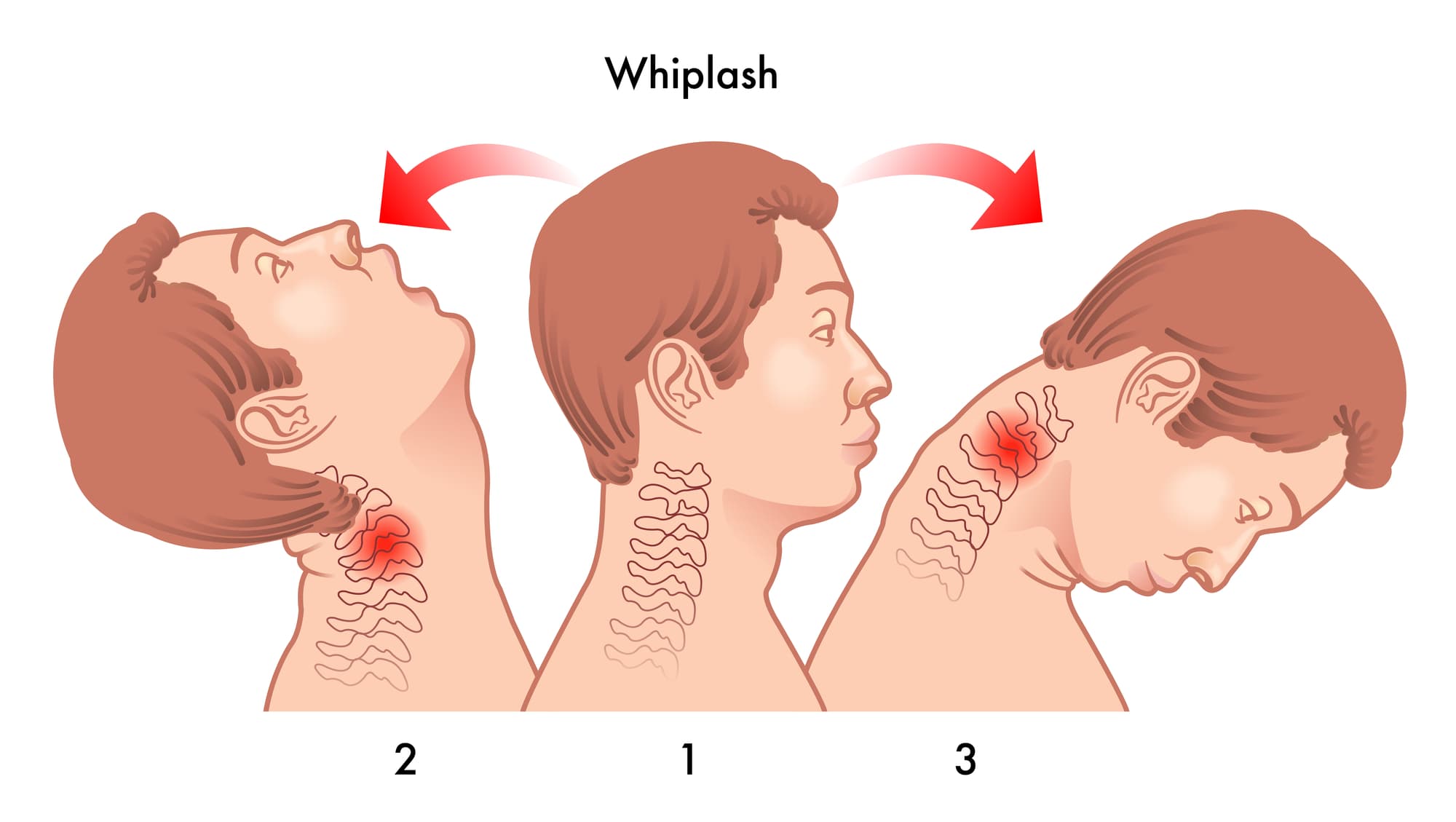
When a vehicle is struck from behind, the damage to the metal and plastic is often obvious. However, the damage to the human spine is frequently invisible, occurring in a timeframe so narrow it defies human biology.
As a specialist in injury treatment, I’ve seen how understanding the four phases of whiplash can help patients better navigate their recovery. Here is what actually happens to your neck during those critical milliseconds of a rear-end collision.
The Four Phases of a Crash
1. The Retraction Phase (The “S-Curve”)
Immediately upon impact, your seat pushes your torso forward. However, your head remains momentarily stationary. This creates a dangerous S-shape in the cervical spine—where the top of your neck flexes and the bottom extends.
- The Clinical Risk: This creates a rapid pressure spike within your spinal canal, often before your head even touches the headrest.
2. The Extension Phase (The “Look Up”)
As your head reaches maximum retraction, it snaps backward into extension. If your headrest is too low or too far back, your neck can undergo hyperextension, stretching the anterior (front) ligaments and muscles beyond their physiological limits.
3. The Rebound Phase (The “Snap Back”)
After reaching peak extension, your head reverses direction and whips forward. This phase produces some of the highest axial and shear forces measured in crash testing. The cervical spine is incredibly vulnerable here as it absorbs massive amounts of energy.
4. The Protraction Phase (The “Seatbelt Constraint”)
Finally, as your seatbelt catches your torso, your head continues its forward momentum. This causes the spine to shift rapidly into a deep flexion, creating a second pressure spike in the spinal canal similar to what is seen in high-impact front-end collisions.
Faster Than a Blink
The most sobering fact about whiplash is the timeline. The entire four-phase process occurs within 50–80 milliseconds.
Expert Insight: To put that in perspective, it takes about 200–300 milliseconds for your brain to process visual information and send a “brace” signal to your muscles. By the time you realize you’ve been hit, the injury process is already over.
Proactive Protection: Your Ergonomic Checklist
Since you cannot react fast enough to prevent injury during a crash, your best defense is your pre-collision setup:
- Headrest Height: The top of the headrest should be at least level with the top of your head.
- Backset Distance: Try to keep the gap between the back of your head and the headrest under two inches (5 cm).
- Seat Angle: Set your seat back between 100 and 110 degrees. This prevents “ramping”—where your body slides up the seat during impact.
- The Golden Rule: Always wear your seatbelt.
The Path to Recovery
If you have been involved in a rear-end collision, don’t wait for “obvious” symptoms like bruising to appear. Because of the pressure spikes and shear forces mentioned above, internal inflammation and joint dysfunction can set in quickly.
Whiplash Treatment in Kenmore, WA
Clinical guidelines consistently identify chiropractic care as an effective, conservative treatment option. By addressing spinal alignment and restoring proper motion, we can significantly reduce pain and long-term disability following a whiplash event. If you or someone you love has been in a car accident call Corner on Wellness Chiropractic Center for an evaluation. We are Bothell’s Whiplash experts.
CONTACT
Better health and wellness is just a click or call away
UPCOMING EVENTS
CLOSED
August 15OPEN 8am
August 22 @ 8:00 am - 11:00 amCLOSED
August 29NO Dr Shay
September 4