






For any rower, the 2,000-meter race is a battle against the “wall.” As lactic acid builds and muscles burn, the stroke power that felt effortless in the first 500 meters begins to fade. While long-distance rows and heavy lifting are staples of training, a new study published in Scientific Reports (2025) suggests that the secret to holding off fatigue might actually be found in explosive “plyometric” training.
In the study, researcher Chun-Hao Chang and his team investigated whether a short, targeted plyometric program could change the way youth rowers handle high-intensity efforts.
The Experiment: 4 Weeks to Better Performance
The researchers recruited 23 youth male rowers and split them into two groups:
- The Control Group: Continued their standard strength and conditioning routine.
- The Experimental Group: Added a 4-week plyometric training program to their routine.
The study wasn’t just looking at how high these athletes could jump; it was looking at how their muscles behaved during a grueling 2,000m rowing ergometer test.
The Result: More Power, Less “Drop-off”
After just one month, the results were clear. The rowers who added plyometrics saw significant improvements in:
- Explosive Power & Maximal Strength: They were stronger and faster off the start.
- Faster 2,000m Times: The plyometric group significantly outperformed the control group in overall rowing speed.
- Muscle Fatigue Resistance: This was the standout finding. Using surface electromyography (sEMG), the researchers tracked the “MDF slope”—a scientific way of measuring how fast a muscle tires out. The plyometric group showed a much slower decline in muscle frequency, meaning their muscles stayed “fresh” and capable of high power output for longer.
How Does It Work? The Stretch-Shortening Cycle (SSC)
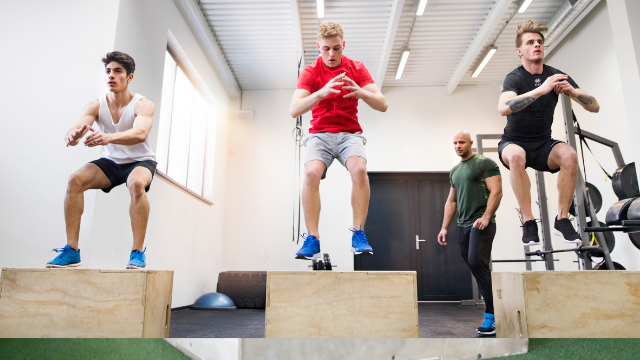
Plyometrics—like box jumps, burpees, and power hops—train the Stretch-Shortening Cycle (SSC). This is the “rubber band” effect in your muscles where they store elastic energy during a quick stretch and release it during the contraction.
By improving the efficiency of this cycle, the athletes’ nervous systems learned to recruit motor units more effectively. In simple terms: they were able to generate the same power with less effort, effectively delaying the point where their muscles began to fail.
Why This Matters for Youth Athletes in Kenmore
Most training programs for youth rowers focus heavily on aerobic capacity. However, this study proves that neuromuscular training is just as vital. Even a short-term (4-week) intervention can:
- Help athletes maintain their technical form under pressure.
- Increase “stroke power” without needing to bulk up excessively.
- Mitigate the risk of injury by preventing the “form breakdown” that happens when muscles get tired.
Practical Takeaways for Coaches and Rowers in Seattle
If you’re looking to boost your performance this season, don’t ignore the “snap.” Integrating explosive movements like squat jumps, lateral hops, and box jumps twice a week can provide a significant “fatigue buffer” that carries over directly to the water.
The Bottom Line: To row faster for longer, you shouldn’t just train your heart and lungs—you need to train your muscles to be more explosive.
Source: Chang, C. H., Chen, C. Y., & Lau, H. T. (2025). The effects of Four-Week plyometric training on delaying muscle fatigue in youth rowers. Scientific Reports, 15(1), 22141.
CONTACT
Better health and wellness is just a click or call away
UPCOMING EVENTS
OPEN 8am
August 22 @ 8:00 am - 11:00 amCLOSED
August 29NO Dr Shay
September 4CLOSED
September 5