






We’ve all been there: you leave a loud concert or a firework display with a faint ringing in your ears. Usually, it fades by morning. But what if that ringing—clinically known as tinnitus—starts after a car accident, and it just won’t go away?
If you’ve experienced whiplash, you might be surprised to learn that the “phantom noise” in your ears might not be coming from your ears at all. It could be coming from your neck.
The Body’s “Wiring” Problem
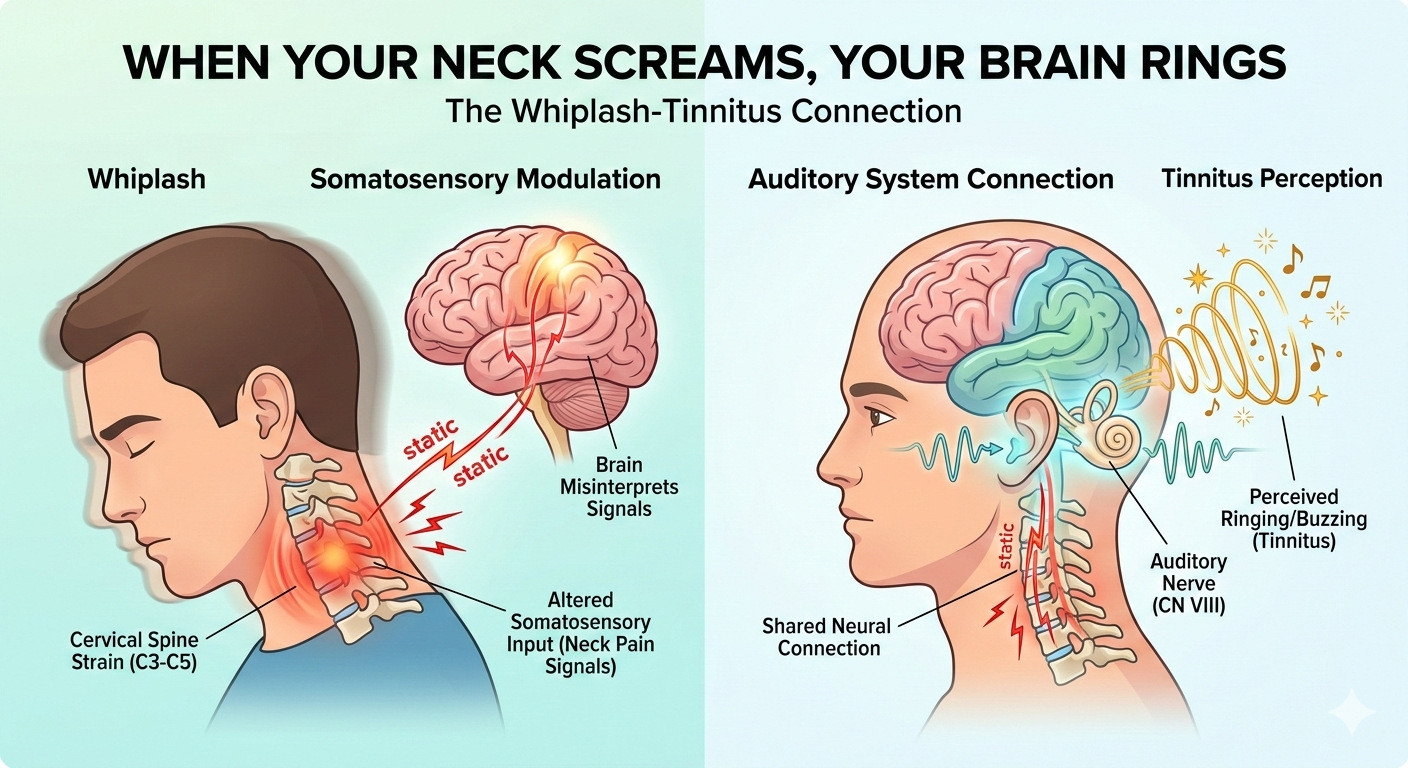
Most people assume tinnitus means you’ve damaged your hearing. However, in cases of whiplash, the mechanism is often somatosensory modulation.
Think of your nervous system like a massive switchboard. Your brain receives signals from all over your body regarding touch, temperature, and where your limbs are in space. These “body signals” and your “hearing signals” actually use some of the same pathways to get to the brain.
When you suffer a whiplash injury, the muscles and joints in your neck are strained. They start sending “static” or “error messages” (pain and tension signals) to the brain. Because the wiring is so close together, your brain can get confused and misinterpret those neck signals as sound.
In short: Your neck is screaming, but your brain thinks your ears are ringing.
New Hope: The June 2025 Study
Recent science is backing this up. In a study published in June 2025, researchers followed 80 people suffering from tinnitus after whiplash.
- The Group Who Got Help: Received manual therapy (adjustments), targeted stretching, and relaxation techniques to ease neck tension.
- The Results: Not only did their neck pain improve, but their tinnitus symptoms significantly dropped. By fixing the “static” coming from the neck, the brain was able to process sound normally again.
How Chiropractic Can Help
If you’re dealing with post-accident ringing, you don’t have to just “live with it.” Because chiropractors at Corner on Wellness Chiropractic Center specialize in the relationship between the spine and the nervous system, they are uniquely equipped to handle this “wiring” issue.
By restoring normal motion to your neck and releasing tight trigger points, chiropractic care aims to:
- Lower the “volume” of pain signals.
- Clear the communication between your body and your brain.
- Improve your range of motion so you can move without discomfort.
Is your neck causing your tinnitus?
If you’ve noticed a persistent ringing since a fender bender or a sports injury, it’s worth looking at the source.
It comes down to shared “wiring” in your brain. The nerves in your neck (the somatosensory system) and the nerves for your hearing (the auditory system) send signals to the same neighborhood in your brain. When your neck is injured, it sends “static” or pain signals that can spill over into the hearing pathway, tricking your brain into hearing a ringing or buzzing sound.
Yes. You don’t need a concussion or a direct blow to the ear to develop tinnitus. The rapid “whip” motion of the neck during an accident can strain muscles and joints enough to disrupt the sensory signals mentioned above. This is known as somatosensory tinnitus.
While some ringing after an accident is temporary, “persistent” tinnitus associated with Whiplash-Associated Disorders (WAD) often requires intervention. If the underlying neck dysfunction isn’t addressed, the brain may continue to misinterpret those signals for months or even years.
Researchers took 80 patients with whiplash-related tinnitus and split them into two groups. One group received manual therapy, stretching, and relaxation techniques aimed at the neck and head. The other group received no treatment. The group receiving therapy saw a significant reduction in both their neck pain and their ear ringing.
Chiropractors focus on the “source” of the static. By using manual adjustments to restore motion to the cervical spine and addressing myofascial trigger points (tight knots in the muscle), they help normalize the signals being sent to the brain. When the neck stops “screaming,” the brain often stops “ringing.”
Chiropractic care is highly effective for somatosensory tinnitus. however, if your symptoms include sudden hearing loss, severe dizziness (vertigo), or if the ringing doesn’t respond to physical therapy, your chiropractor may refer you to an ENT (Ear, Nose, and Throat) specialist or a neurologist to rule out direct damage to the inner ear.
CONTACT
Better health and wellness is just a click or call away
UPCOMING EVENTS
CLOSED
October 24CLOSED
October 31Chiro AM ONLY
November 2Dr Shay AM Only
November 4